First decision: which honey business are you actually starting?
Before anything else, separate three businesses that get talked about as if they were one. They share a product and nothing else — different capital, different skills, different risk, different thing you own at the end.
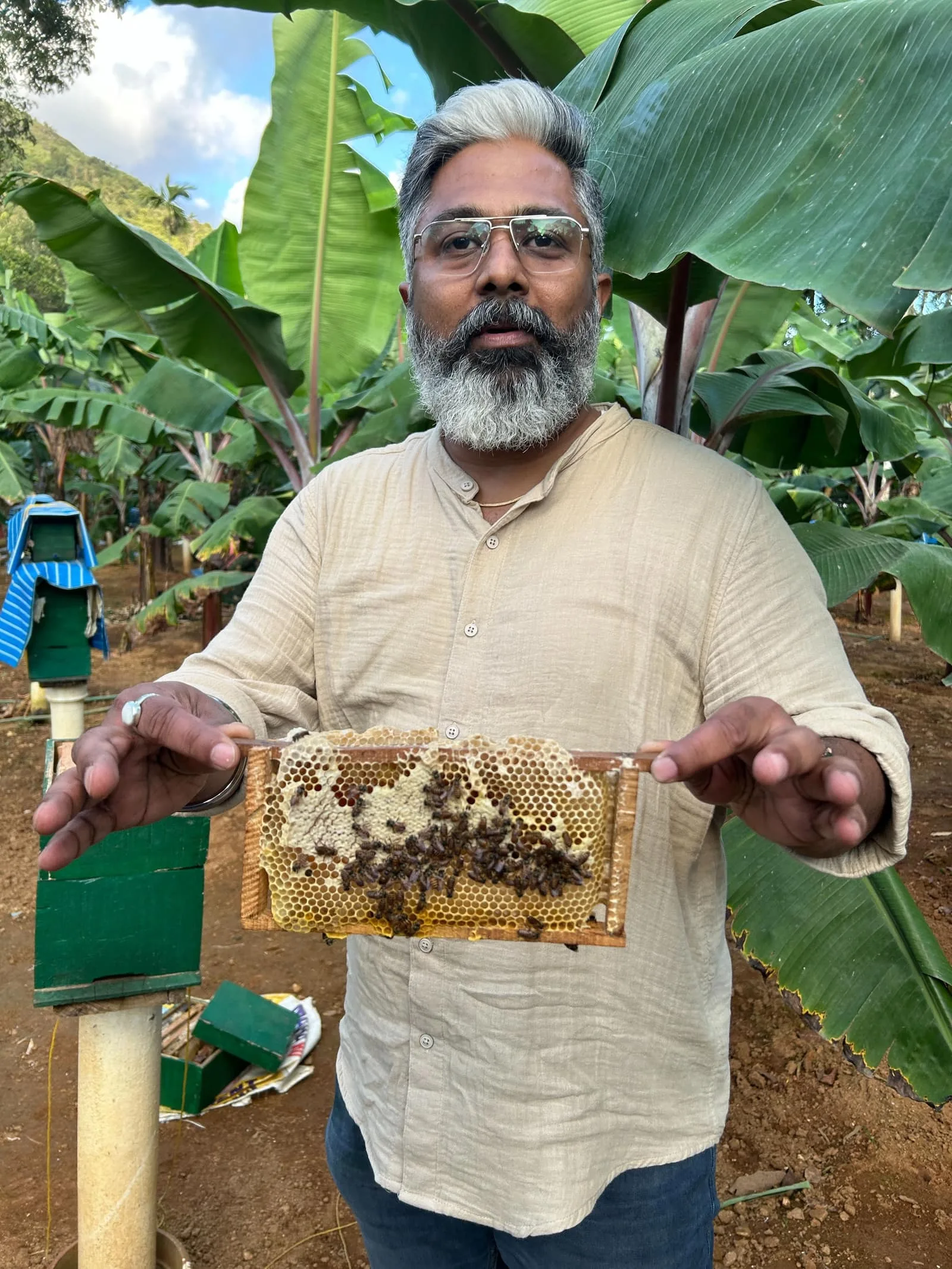
1. Beekeeping (apiculture) — you produce the honey
You buy colonies and hives, learn bee management, and harvest your own honey. It is a genuine agricultural business with a season, a weather risk and a learning curve. Godrej Capital’s 2026 guide to the sector puts a beginner setup of 50 colonies at roughly ₹1–2 lakh in initial investment, with equipment, protective gear, an extractor and first-season working capital on top of the colonies themselves; it estimates a healthy Apis mellifera colony yields about 20–40 kg of honey a year and that most small-to-medium operations reach net profit within one to two years. Government support exists — the National Bee Board, NABARD refinance schemes and state subsidies — and it is real money worth claiming if this is your path.
What you should know honestly: this is farming. Colony health, varroa mites, pesticide drift from neighbouring fields and a bad flowering season are your operational reality, and the thing you own at the end is production capacity, not a brand. Many excellent Indian beekeepers still sell in bulk at commodity rates because production and marketing are separate skills. If you want to keep bees, keep bees — but pick it because you want to farm, not because you think it’s the entry point to a honey brand.
2. Trading and aggregation — you buy and resell
You buy honey from beekeepers or processors and sell it on, either unbranded in bulk or in simple packaging. Capital is almost entirely stock: no hives, no equipment, no season to wait out, and you can start and stop at will. It is the fastest way to learn what actually moves in your market and who the real buyers are.
The honest limitation is that you are competing on price in a market where someone can always buy a rupee cheaper, and you accumulate no asset. Every sale is a fresh negotiation, margins compress as volume grows, and you own no shelf position, no repeat customer and no brand equity. Plenty of people make a living here. Very few build something they can sell.
3. Private label — you own the brand, a partner makes the product
You define the brand, the varietal range, the packaging and the price. A sourcing-and-packing partner handles beekeeper networks, filling, labelling, batch testing and documentation. You never touch a hive, and the asset you build is the brand.
Capital here is not equipment — it is your first production run plus the brand around it. Our own numbers make this concrete. A standard private-label minimum is 120 kg per variant, which in the most common format (250g) is 480 jars. At the all-in per-jar cost we publish in our honey brand unit economics breakdown — ₹67–87 for a standard multifloral, ₹132–172 for a premium monofloral with monocarton — that first batch is roughly ₹32,000–42,000 in stock at the standard end, or ₹63,000–83,000 premium. That same 480-jar batch carries gross revenue potential of about ₹1.43 lakh at ₹299 retail, or ₹2.4 lakh at ₹499. Add brand, design, compliance and launch costs on top of the stock — the MOQ piece explains why 120 kg is a market test rather than a warehouse commitment.
The trade-off is real and worth stating: you do not control production, so your partner choice is your quality control. That is exactly why the proof section below matters more on this path than on either of the others.
The three models, side by side
- Beekeeping — ~₹1–2 lakh for 50 colonies (Godrej Capital, 2026). You own production. Farming skills, seasonal risk, 1–2 years to profit.
- Trading — capital is stock only, no equipment. Fastest start, thinnest margin, and you build no asset.
- Private label — from ~₹32,000 in first-batch stock (120 kg / 480 jars, standard multifloral) plus brand and compliance costs. You own the brand; your partner owns production.
The rest of this playbook covers the third path, because it is the one most founders who search for this are actually describing — and the one where the decisions are least documented. If you are choosing between the three, that conversation is worth thirty minutes before you spend anything.
Why now is the right window for a new honey brand
Here is the strange gift of the last few years: Indian honey buyers stopped trusting honey. After the 2020 adulteration findings made national news, “is this even real honey?” became the question behind every purchase. The big names lost something they may never fully win back — the benefit of the doubt.
That lost trust is your opening. A new brand built on honest sourcing and real proof doesn’t have to dislodge a loyal customer from an incumbent; it has to meet a skeptical one who is actively looking for someone better. Add the steady pull of wellness, Ayurveda and premium gifting, and you have rising demand and falling trust in the same market. You don’t need to manufacture demand. You need to earn belief where others spent it.
Centre for Science and Environment testing in November 2020 found that 10 of 13 major Indian honey brands — roughly 77% of those tested — failed NMR purity testing, exposed for adulteration with modified rice syrups. That is the trust gap a new, honestly-proven brand can step into.
Centre for Science and Environment, November 2020The four decisions to make before you ever pick a varietal
Most first-time founders start at the jar — the label, the name, the honey they tasted on a trip. Start earlier. Four decisions come before the product, and they quietly determine everything after it:
- Who is it for? A diabetic-conscious buyer, a young wellness shopper, a corporate gifting manager and a kirana customer are four different brands. Pick one to win first.
- What does it stand for? Ayurvedic, premium, everyday, or gifting. This is positioning, and it decides your varietal, your packaging and your price — not the other way around.
- Where will it sell? Direct-to-consumer, Amazon, modern trade, gifting, or distributors. Each channel has its own margins, pack sizes and proof expectations.
- What proof will you offer? Decide your trust stack — Certificate of Analysis, FSSAI testing, lab documentation — before you design the label, because in 2026 the proof is part of the product.
Get these four right and the rest of the build stops being guesswork. Get them wrong and no amount of beautiful packaging will save the brand.
Varietal selection: the decision that shapes your margin, your story and your buyer
Don’t choose your varietal by which one tasted best on holiday. Choose it by the job it does in your range. In India, honey sorts into three working tiers:
Volume workhorses — multifloral and mustard. Daily consumption, mass appeal, thinner margins carried by volume. This is your cash flow.
Monofloral premiums — jamun, litchi, tulsi, ajwain, eucalyptus. These carry a story and a function (jamun for the diabetic-conscious, tulsi for immunity, ajwain for digestion), they earn higher margins, and they drive repeat purchase from people with a routine.
Hero varietals — sidr, acacia, wild forest. Small volumes, premium prices, the gifting halo and the NMR-and-origin story.
The portfolio that works is rarely one honey. It’s a base for cash flow, a monofloral or two for margin and repeat, and maybe one hero for the brand’s halo. A word of honesty most suppliers won’t offer: some of the most-hyped names — “Himalayan,” vaguely-sourced “wild forest,” imported sidr — are the easiest to fake and the hardest to back with real provenance. Pick varietals you can prove. You can explore the full range and what each one is actually good for before you decide.
FSSAI: what registration you actually need
You cannot sell honey in India without the right FSSAI registration — and which one you need depends on your scale. A small home-scale start, a growing brand, and a multi-state operation sit at different levels of the FSSAI ladder. Picking the wrong one either stalls your launch or boxes in your growth.
The part that trips up first-timers isn’t the licence itself — it’s the label. Honey carries a set of mandatory declarations, and founders routinely miss two or three: the botanical or floral source, batch and best-before details, net weight rules, the FSSAI logo and licence number, and the specific claims you are and aren’t allowed to make. A label that’s beautiful and non-compliant is just an expensive reprint waiting to happen. Map compliance to your exact plan before anything goes to print.
Not sure which FSSAI level or which varietal fits your plan? That’s the whole point of the call.
Book your 30-min strategy call — ₹299, credited to the buildProof: why your buyers will ask, and what to actually do about it
Within your first year, a serious buyer — a distributor, a modern-trade listing, a corporate gifting client, or just a sharp customer — will ask the question: how do I know it’s pure? Have the answer ready before they ask it.
For an Indian honey brand, the honest, reliable answer is correctly-performed FSSAI testing paired with a Certificate of Analysis on every batch. NMR — the test everyone has heard of since 2020 — is powerful for catching sugar-syrup adulteration, but it has a real blind spot for India’s diverse floral honeys, and it isn’t a legal requirement. We unpack exactly why in our piece on whether NMR is the gold standard for Indian honey. The short version: build your proof around FSSAI and batch-level documentation, and treat NMR as an extra you reach for when a specific buyer demands it. You can see how we document purity on our Quality & Certifications page.
The cost map: what launching a honey brand actually takes
Let’s talk money honestly, because vague answers help no one. Your costs fall into four buckets: the product (honey, jars, labels, caps), compliance (FSSAI, lab testing, documentation), brand (name, design, photography, a launch-ready website), and launch (your first stock and the plan to sell it).
The product cost scales with your order and your varietal — a volume multifloral and a premium sidr live in very different places. Rather than quote a number that won’t fit your plan, we built a tool that does it properly:
Configure your varietals, formats, label and volume in our quote builder and get an indicative per-jar estimate — so you’re costing your brand on real numbers, not guesses.
Build your indicative quote ›One trap to avoid: don’t budget only for the honey. The brands that struggle are the ones that spent everything on stock and nothing on the proof, the design and the plan that actually sell it.
What 8 to 12 weeks actually looks like
“A few months” is not a plan. Here is the real shape of a build when someone is handling the moving parts for you:
Weeks 1–2 — Strategy & sourcing. Lock the four decisions, choose your varietals, and start sourcing against them.
Weeks 3–4 — Sampling & approval. You taste real samples and approve the honey before anything is committed.
Weeks 5–6 — Packaging & compliance. Labels designed to FSSAI rules, formats finalised, documentation underway.
Weeks 7–9 — Production & quality. Your honey is filled to spec, with batch-level testing and a Certificate of Analysis.
Weeks 10–12 — Launch. Your website, catalogue and launch assets come together, and your first stock is ready to ship.
Most builds land inside that window. A few choices carry their own clocks — an out-of-season varietal, a state-level licence, fully custom glass — and those get flagged on the first call, before you commit, so the timeline you’re given is the timeline you get.
Pricing for margin, without racing to the bottom
You will be tempted to compete on price. Don’t. The cheapest honey on the shelf is cheap for a reason, and that is precisely the reputation you’re building a brand to escape. Price for your positioning instead: work backwards from where your buyer shops and what they expect to pay there, leave room for your channel’s margins, and let your proof and your story justify the number. A well-positioned monofloral with real documentation can hold a healthy premium that a generic multifloral never will. Margin lives in trust and story, not in shaving rupees.
Your first move
You don’t need to become a honey expert. You need one who is accountable to you — to map the four decisions to your specific idea, choose varietals you can prove, handle the FSSAI maze, and give you a real timeline and a real number. That’s the entire point of the strategy call: thirty structured minutes, and you walk away with the plan whether or not we build it together.
The short version
- Pick your model first: beekeeping (you own production, ~₹1–2 lakh for 50 colonies per Godrej Capital’s 2026 guide), trading (stock capital only, no asset built), or private label (you own the brand, from ~₹32,000 in first-batch stock plus brand costs).
- On the brand path you don’t need bees, a factory or years of experience — you need the right decisions in the right order.
- Decide who it’s for, what it stands for, where it sells and how you’ll prove it — before you pick a varietal.
- Get FSSAI level and label declarations mapped before you print; build proof around FSSAI testing + per-batch CoA, not NMR.
- Budget for the whole brand, not just the honey, and price for positioning. A guided build runs about 8–12 weeks.